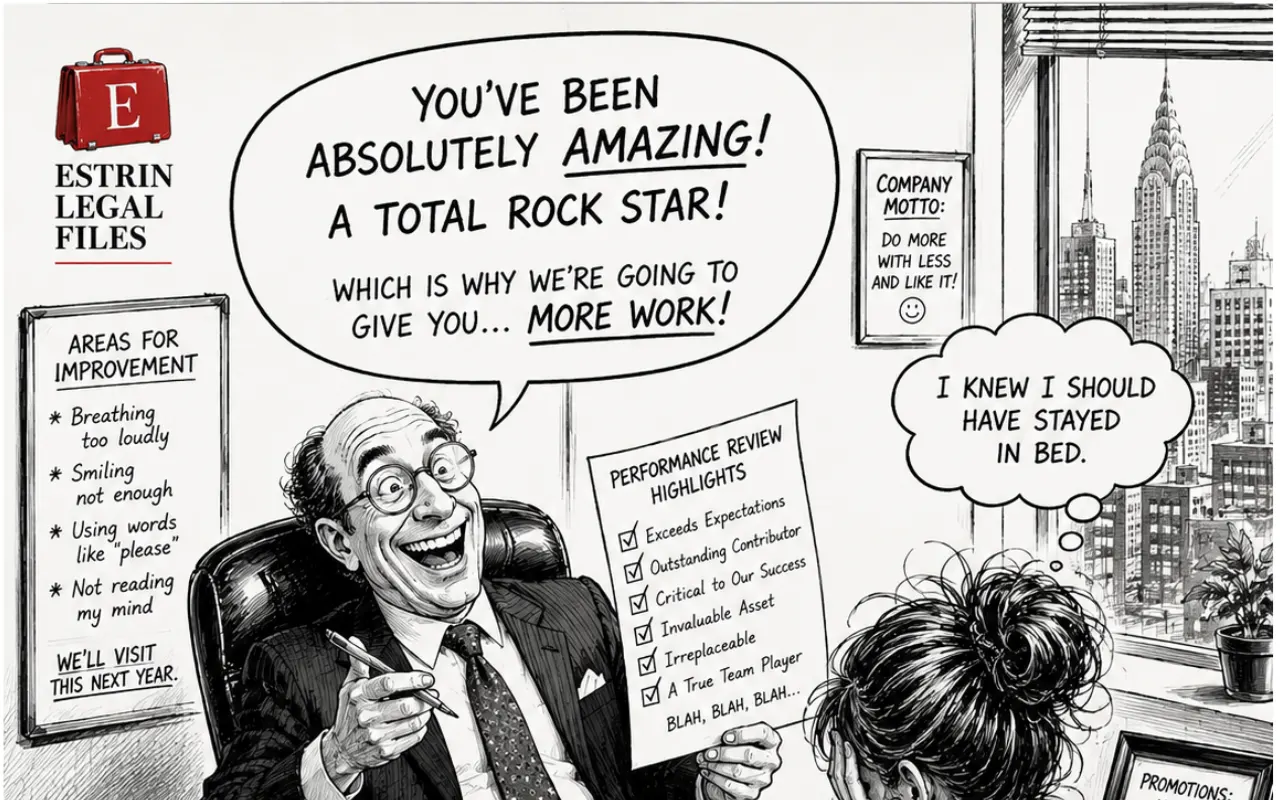
There are few workplace traditions quite as bizarre as the annual performance review.
Once a year, you are invited into a conference room—or, these days, onto a Zoom call—to learn how you’ve apparently been doing for the previous 12 months.
Twelve months.
That’s 365 days of work, deadlines, emergencies, impossible clients, last-minute filings, partner requests, new software, staffing shortages, late nights, early mornings, and at least one printer that sensed fear.
And now, at 2:00 on a Thursday afternoon, someone is going to tell you how it all went.
Welcome to performance review season.
That magical time of year when you find out something you did in February has apparently been bothering someone since February.
Nobody said anything in March.
Or April.
Or May.
But good news.
Gary wrote it down.
“You Had an Outstanding Year.”
Terrific!
“You really stepped up.”
Thank you!
“The attorneys love working with you.”
Wonderful!
“You’ve become an invaluable member of the team.”
Fantastic!
“Your raise is 2.8%.”
Wait.
What?
Suddenly, “invaluable” appears to have a surprisingly specific value.
And if you dare look confused, you may hear one of the great classics of performance-review theater:
“Raises are based on a number of factors.”
Which factors?
Nobody knows.
They are kept somewhere with the nuclear codes.
Of course, employees talk.
Management occasionally seems genuinely surprised by this.
Gary got the biggest raise.
How do we know?
We know.
We also know who got a bonus, who didn’t, who got 3%, who got 5%, who got an extra week of vacation and who somehow negotiated Fridays from home.
We know Gary went into the managing partner’s office at 10:00 and came out at 10:42 looking like he’d just purchased a small island.
By lunch, Accounting knew.
By 2:00, Litigation knew.
By 4:00, someone in the Denver office knew.
Law firms can keep multimillion-dollar client matters confidential, but Gary’s raise?
Please.
Then There’s the Mysterious Rating System
“You did an exceptional job this year.”
Great. So, a 5?
“No one gets a 5.”
I’m sorry?
“No one gets a 5.”
Then why is there a 5?
Why not make the scale 1 through 4?
Or 1 through 3.7?
Or simply:
Excellent
Good
Gary
My personal favorite is when your manager explains that giving you the highest rating would mean there is “no room for improvement.”
Of course there’s room for improvement.
There’s room for improvement in Meryl Streep.
That doesn’t mean you give her a 3.6.
Surprise! Here’s Something You Did Nine Months Ago.
This may be the strangest part of the entire process.
“You know, there was an incident last November…”
Last November?
I have trouble remembering my dog’s name. Could you narrow this down a little bit?
Apparently, however, nine months ago you sent an email that someone thought was “a little abrupt.”
Did anyone tell you?
No.
Did anyone ask what happened?
No.
Did the client complain?
No.
Did the attorney mention it?
No.
But it has been carefully preserved like an artifact from Pompeii so it could be unveiled during your annual performance review.
Why?
If something is wrong, tell employees when it happens.
If someone needs coaching, coach them.
If someone made a mistake, address it.
If someone’s behavior needs to change, give them the opportunity to change it.
Saving criticism for nine months isn’t management.
It’s scrapbooking.
And Then Comes the Good Stuff You Never Heard Either
Here’s the flip side.
“You’ve really become one of the strongest people in the department.”
Really?
“We’ve been extremely impressed with your work.”
You have?
“Several attorneys specifically mentioned how much they rely on you.”
They did?
“Your judgment has really developed.”
Fantastic.
If I was so good, why didn’t I know about it?
Why are we rationing compliments like they’re wartime sugar?
Employees shouldn’t have to wait 12 months to find out they’re doing a great job.
Tell them.
You know what happens when you don’t?
Someone else does.
Sometimes that someone is a recruiter.
And recruiters have this funny habit of saying things like:
“Your background is exactly what our client is looking for.”
“You’re under market.”
“There’s room for advancement.”
“The salary range is $25,000 higher than what you’re making.”
Suddenly that annual “You’re invaluable” conversation has some competition.
“We’ll Visit This Next Year.”
Ah.
The sentence that has launched a thousand résumés.
You ask about promotion.
“We’ll visit this next year.”
You ask about changing your title to reflect the job you’ve already been doing for 18 months.
“We’ll visit this next year.”
You ask about a salary adjustment.
“We’ll visit this next year.”
Leadership opportunity?
Next year.
Professional development?
Next year.
Hybrid schedule?
Next year.
At some point, “next year” stops sounding like a timeline and starts sounding like a storage facility.
Especially when next year arrives and somehow…
nobody got promoted.
Which raises a fairly reasonable question:
Why?
There were promotions available in theory.
People exceeded expectations.
Responsibilities increased.
The firm had a good year.
Employees took on more.
So where did the promotions go?
Did they get lost with the 5s nobody is allowed to receive?
“We’d Like You to Take on More Responsibility.”
This is another performance-review favorite.
Translation:
You have done such a wonderful job performing your current responsibilities that we would like to reward you with some additional responsibilities.
Title?
Not yet.
Promotion?
Let’s see how it goes.
Compensation?
“We can revisit that.”
When?
Come on. You know this one.
Next year.
This is how excellent employees slowly acquire three jobs while remaining officially employed in one.
Then management is shocked when they leave.
“She seemed so happy!”
Did she?
Or was she just competent?
There is a difference.
Why Now?
This may be the question firms should be asking themselves about annual reviews.
Why now?
Why does meaningful feedback happen according to the calendar instead of when it’s meaningful?
Imagine managing client relationships this way.
“Mrs. Johnson, we’ve had some concerns about your case strategy since March, but we’ll discuss them during your annual client review in December.”
You’d never do that.
Yet firms routinely manage their most valuable people that way.
Performance management should be happening all year.
Not necessarily through formal meetings, forms, ratings, committees and seventeen boxes requiring comments.
Sometimes it takes 30 seconds.
“Great job on that deposition summary.”
“I noticed how you handled that client.”
“You’ve been staying late a lot. What’s going on?”
“You’re ready for more responsibility.”
“That wasn’t your best work. Let’s talk about what happened.”
“Where do you want to go from here?”
That’s management.
And Please Stop Making Employees Write Their Own Reviews
You know this ritual.
The self-evaluation.
“Please summarize your accomplishments for the year.”
So you spend three hours documenting everything you accomplished.
Revenue saved.
Cases supported.
People trained.
Processes improved.
Clients rescued.
Technology learned.
Crises averted.
You carefully polish it, submit it and wait.
Then, during your review, your manager opens the document and says:
“You had a very productive year. You trained three new employees, implemented the new intake procedure and took over the Henderson matter…”
Yes.
I know. I wrote that.
Nothing builds confidence in the performance-review process quite like discovering you’re apparently also responsible for conducting it.
Here’s the Part That Isn’t Funny
Good employees rarely leave because of one bad performance review.
They leave because of what the review reveals.
They discover there is no path forward.
They discover increased responsibility isn’t leading anywhere.
They discover their compensation has fallen behind the market.
They discover the promotion they’ve been waiting for isn’t coming.
They discover management thinks they’re terrific—but apparently not terrific enough to invest in.
Or worse, they discover nobody has really been paying attention at all.
A performance review should not be the annual unveiling of management’s secret opinion of you.
There should be very few surprises.
Employees should already know where they stand, what they’re doing well, what needs improvement, where they’re headed and what they need to do to get there.
And if someone is truly exceptional?
For heaven’s sake, tell them before somebody else does.
Because while you’re waiting to “visit this next year,” Gary already knows what he got.
So does Accounting.
So does Litigation.
And by now, probably Denver.

Cherie, this is SPOT ON! You’ve nailed it! This is a spectactular summary of the entire performance review process as it really is. Thank you for your valuable insights. It’s the sad truth, yet I’m still rolling on the floor laughing! “Nothing builds confidence in the performance-review process quite like discovering you’re apparently also responsible for conducting it.”
Heidi — this made my whole week. And I love that you pulled that line out, because writing it was basically journaling at that point. Here’s the part nobody warns you about: once you start noticing the absurdity, you can’t stop. Now every “we’ll circle back next year” sounds like a punchline. Thanks for laughing with me instead of just filing this under “too real” and closing the tab. See you at next year’s festival — I hear Gary’s already lobbying for a bigger raise.
This article is excellent. You captured so many of the challenges with the annual performance review process so clearly, and somehow, so hilariously. Every point resonated with me, and I found myself nodding and laughing along as I read it. You did such an incredible job putting into words what so many leaders and employees experience with the traditional review process.
Stacey — thank you, genuinely. That’s exactly the reaction I’m after: the laugh followed by the wince. The truth is this piece wrote itself after enough years of watching smart, hardworking people find out in a December conference room what everyone else already knew in March. My hope is that a few leaders read this, recognize themselves in “we’ll visit this next year,” and actually change something before their best people start returning recruiters’ calls. Appreciate you taking the time to say so.